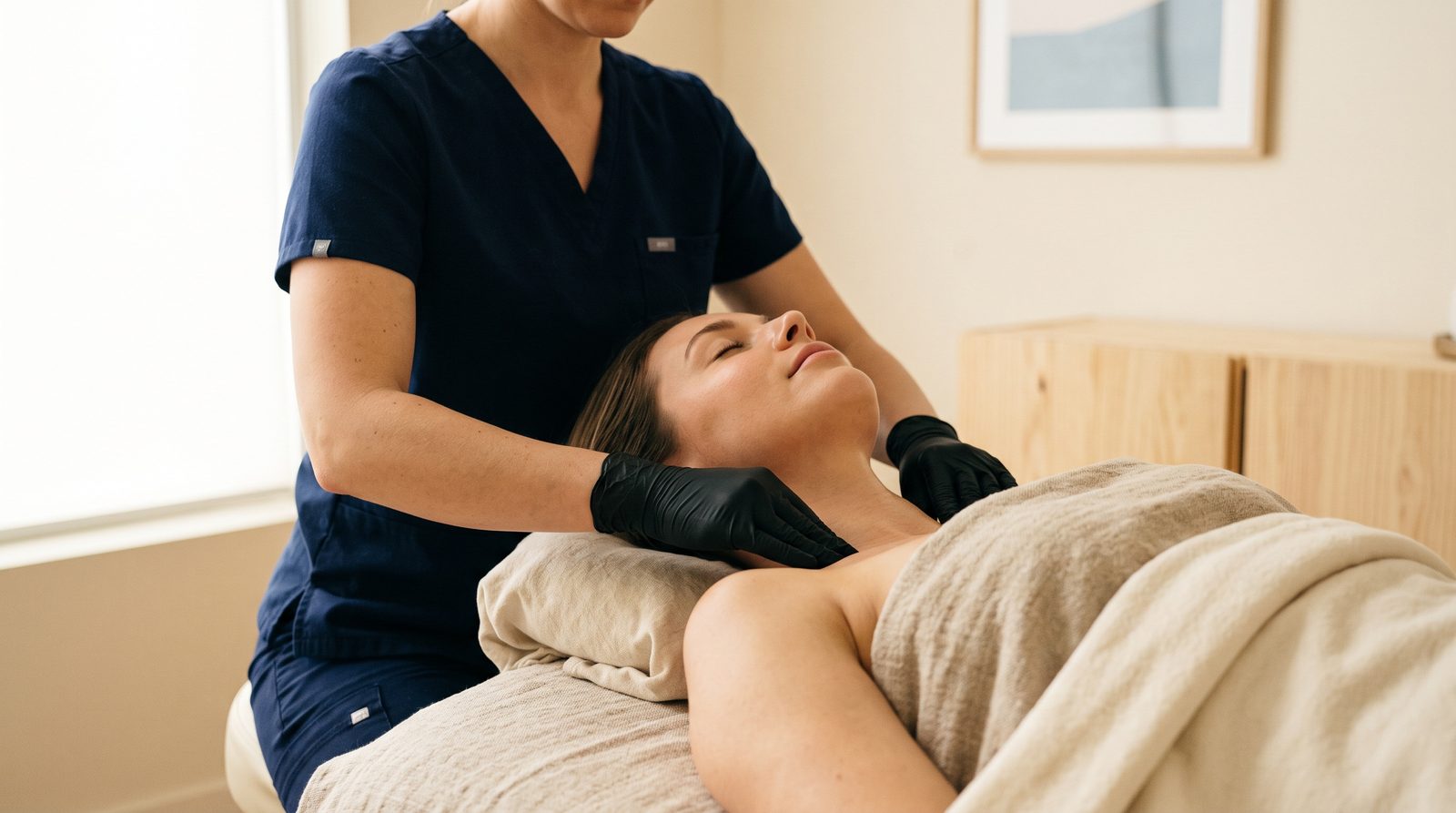
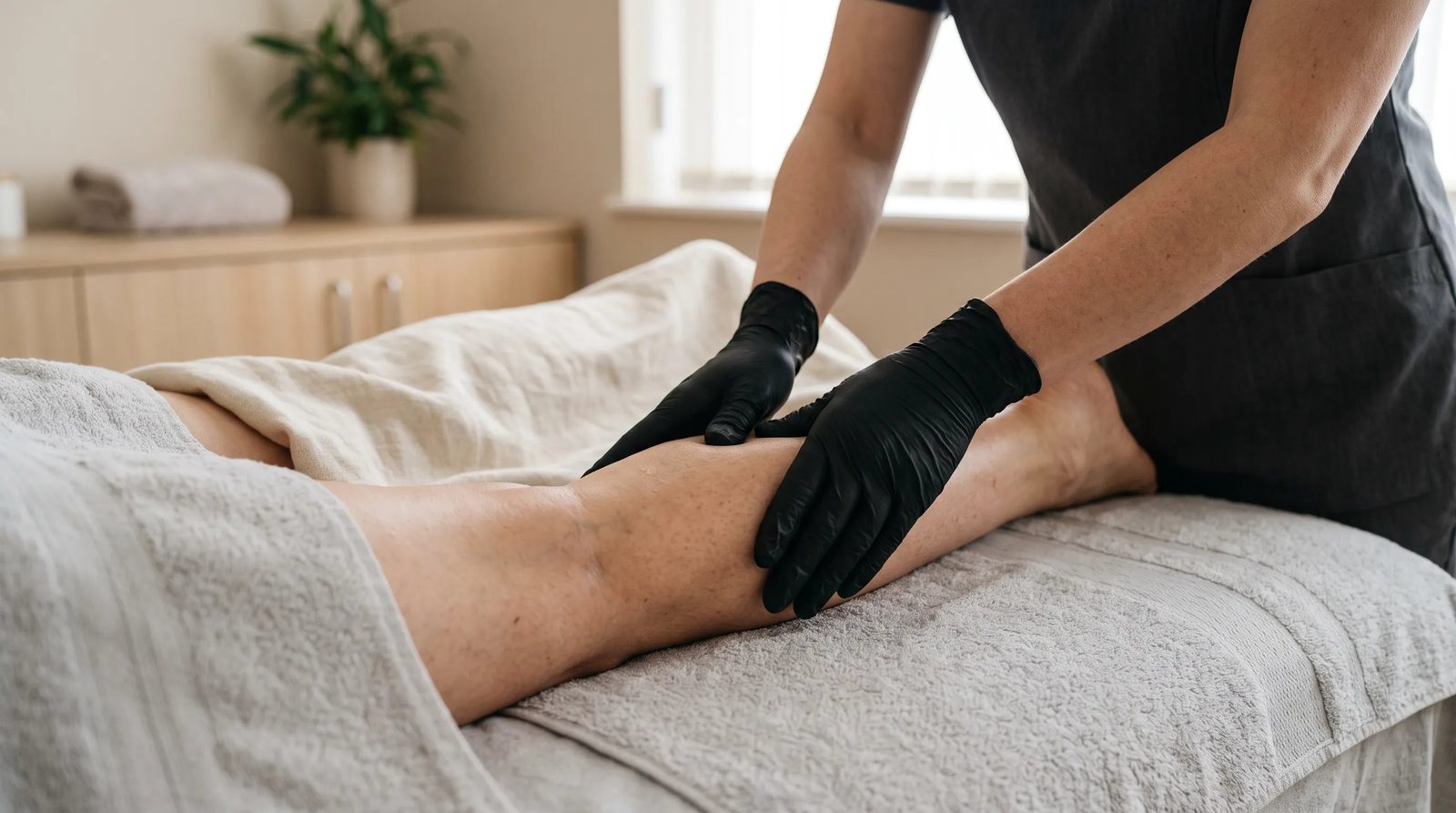
The knee moved fine. That was the strange part. A patient came to us with a left knee that bent, straightened, and carried weight the way it was supposed to, and it was still puffy weeks after the injury should have quieted down. Her physical therapist had checked the mechanics and found them sound. The swelling was the one thing that would not resolve, so he sent her to us on a hunch that the fluid, more than the joint, was holding her back. That story turns out to be common. When an injury heals but the swelling lingers, the trouble is often less about the bone or the ligament and more about the quiet second circulation that clears fluid out of the tissue. This is a look at what that swelling is, why physical therapists and physicians refer people to lymphatic work for it, and what two patients said about their own recovery.
Why does swelling stay after an injury heals?
Any injury, from a rolled ankle to a knocked knee, floods the area with fluid. That swelling is part of healing, and most of it drains away on its own over the following days. The system doing that draining is your lymphatic network, a web of thin vessels that picks up the extra fluid your tissues leave behind and carries it back toward the center of your body.
Here is the detail that catches people off guard. Your blood has a pump in your heart. Your lymphatic system has none. It moves fluid through muscle movement, breathing, and gentle stimulation, which means that after an injury, when you are resting the area and moving it less, the drainage can fall behind exactly when there is the most to clear. The joint recovers. The fluid sits. That gap is the space where manual lymphatic drainage does its work. Our manual lymphatic drainage page walks through the mechanism in full.
What did the knee-swelling patient experience?
The patient with the lingering knee swelling described the referral in her own words:
"I came in with a swollen left knee and my physical therapist recommended lymphatic massage because my knee functions properly but we couldn't figure out why the swelling. So he recommended trying this to see if it would reduce the swelling and therefore reduce my pain."
She had been to us before, so she already knew the sensation of the work, and she was clear about how it felt this time:
"Super comfortable. Super relaxing."
Asked whether the swelling had moved, she kept it short:
"It has. It is working great."
That is one person describing one course of care, and we share it as her individual experience rather than a promise of what anyone else will feel. What it does illustrate is the referral pattern: a movement specialist confirmed the joint was fine, recognized the holdout was fluid, and pointed her toward the system built to move it.
Why do physicians refer patients for lymphatic massage?
Physical therapists are one referral source. Physicians are another, and one of them put his reasoning on camera. Dr. Matt Vogt of the Sports Medicine and Regenerative Therapeutics Institute (SMaRT) in Hinsdale, Illinois, sees chronic lower-body swelling in his own practice and explained where he sends it:
"On occasion I will have patients with chronic swelling of the lower extremity. Often I will refer these patients for lymphatic massage therapy. Patients I've referred to the National Lymphatic Center have had excellent results. I find that patients who need lymphatic massage therapy will often heal their orthopedic injury more quickly."
That is a physician describing what he observes in the patients he refers, and we present it as his professional experience. His point lines up with the physiology. When fluid clears on schedule, the tissue underneath has an easier time settling, which is why a clinician managing an orthopedic recovery may fold lymphatic work into the plan. For patients arriving from a surgical or clinical referral, our medical massage page covers how we work alongside that care.
Can swelling from an old injury still respond?
Sometimes the swelling is not weeks old. It is years old. Another patient came to us long after the original accident:
"I had broken my ankle in a bicycle accident about seven years ago, and throughout physical therapy I said, why am I getting this swelling in my ankle and it won't go down? And they say, oh, that has to do with your lymphatic system, and it just needs to regenerate itself over time."
He had lived with it for years before starting lymphatic work, and he described how the sessions went from there:
"I started with Sharon Vogel and really, almost from day one, has been very successful."
What he valued as much as the result was understanding what was happening to him along the way:
"Sharon Vogel is somebody that was very informative, would go over different aspects of the therapy that she was giving me, and I found it to be extremely helpful. I found her and her staff to be one hundred percent trustworthy and easy to work with."
Again, this is one person's account of his own recovery, offered as his experience and not a typical outcome. His story is here to show that fluid stranded by an old injury can still be a candidate for manual work, which is worth knowing for anyone who assumed the window had closed.
Is lymphatic massage right for every injury?
Honesty matters more than reassurance here, so a few limits are worth stating plainly. Lymphatic work is supportive care that helps fluid move. It does not cure an injury or condition, and it is not right for everyone. Some situations need a physician's involvement first, including certain heart and lung conditions, blood clots, and active infections, and we refer those cases to a hospital lymphedema clinic where emergency care is on hand. That screening comes before anything else.
The right starting point is often a conversation with the clinician already managing your recovery. A physical therapist or physician who knows your case can say whether fluid is the piece that is lagging, the same way both patients above arrived through a referral. For swelling that follows a procedure, our post-surgical lymphatic massage page is the better place to begin.
What to do about swelling that will not settle
If an injury has healed on paper and the puffiness has not gotten the message, the fluid is worth a second look. Movement, elevation, and time do a great deal on their own, and when they stall, trained manual lymphatic drainage is the next step, ideally with your referring clinician in the loop.
If you are dealing with swelling that lingers after an injury, tell us what is going on and we will say honestly whether this work can help, then book you through our online booking page once we know it is a fit. You can also keep reading through our education library for more on how the lymphatic system moves fluid.