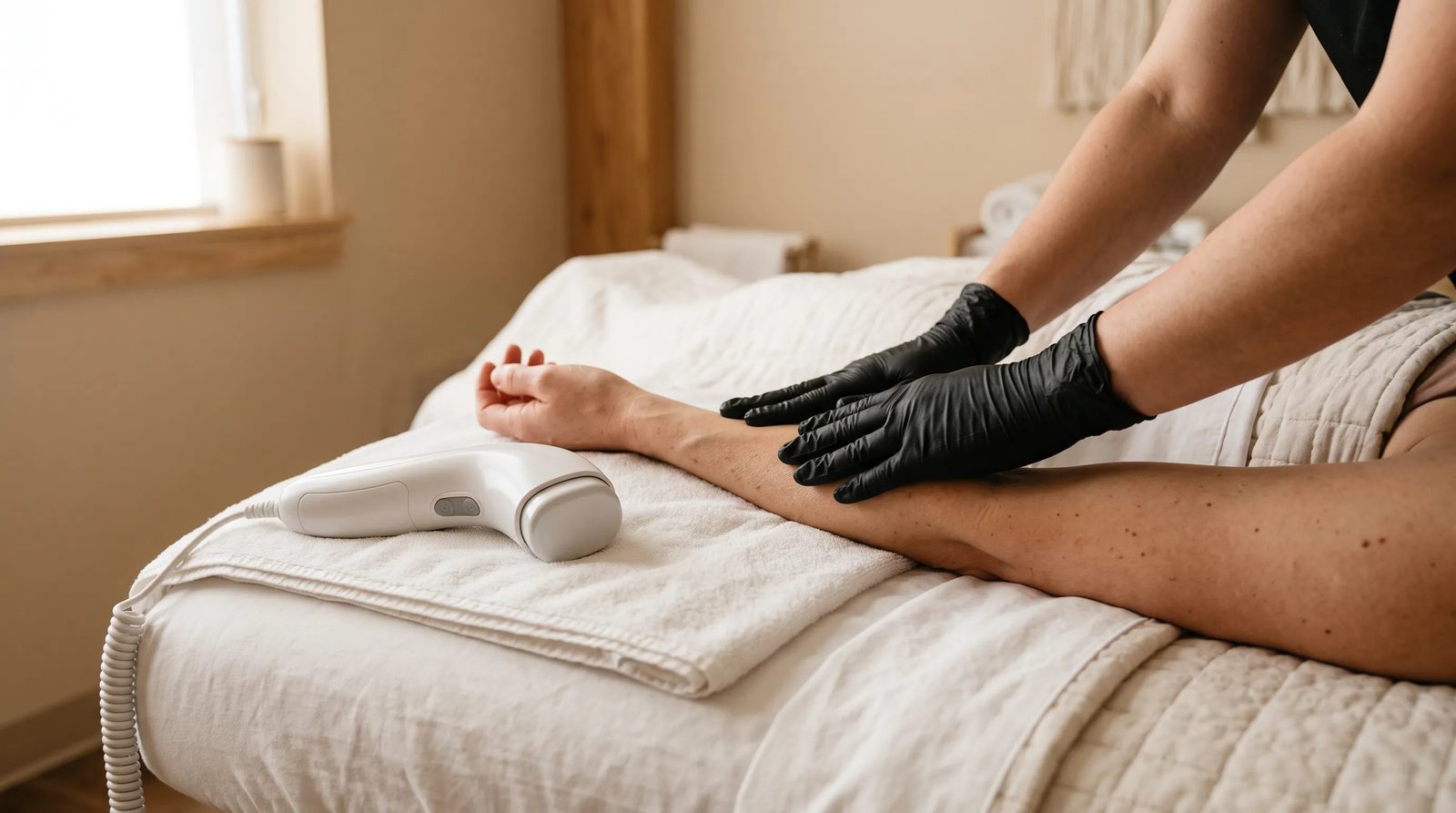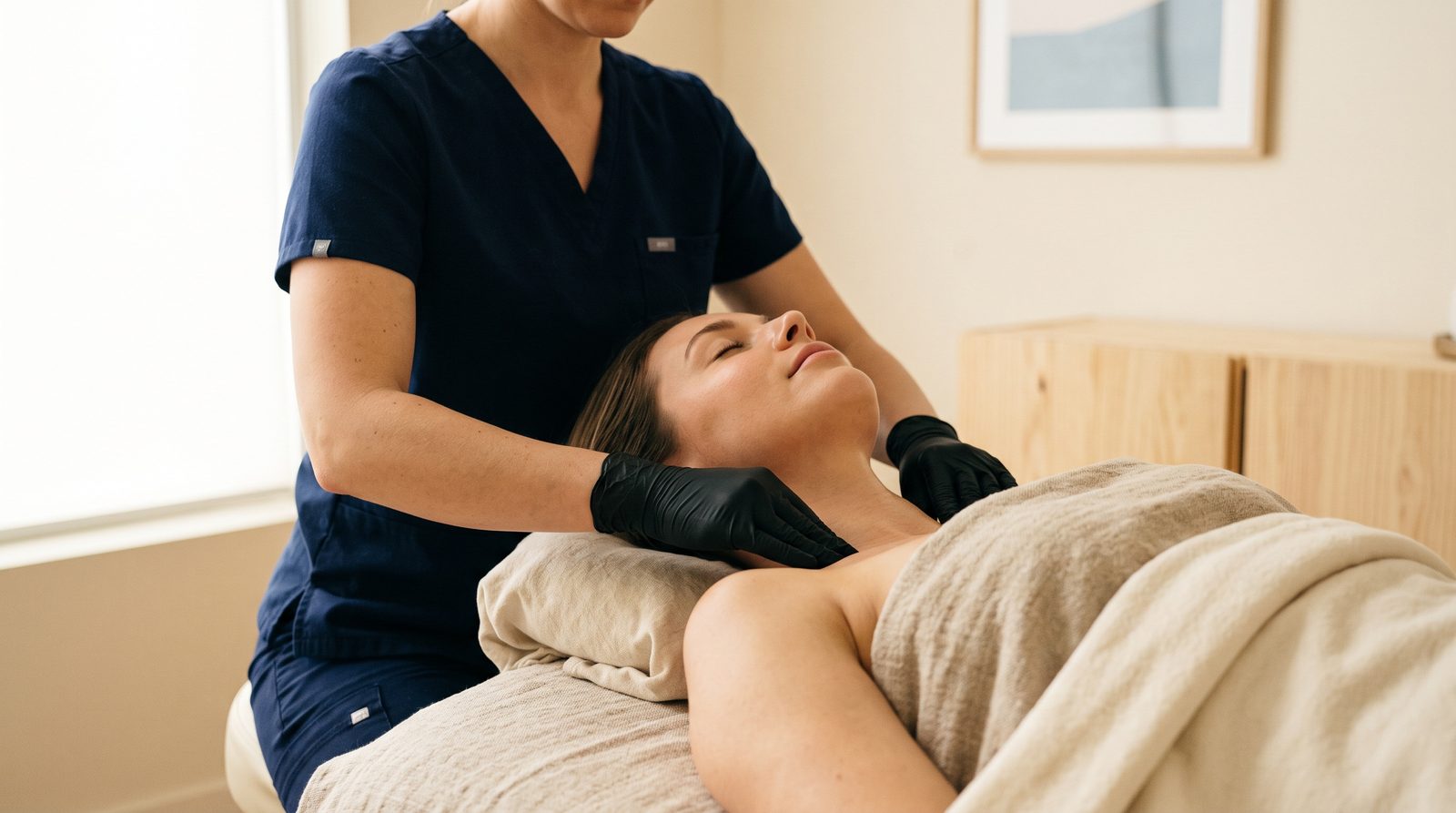
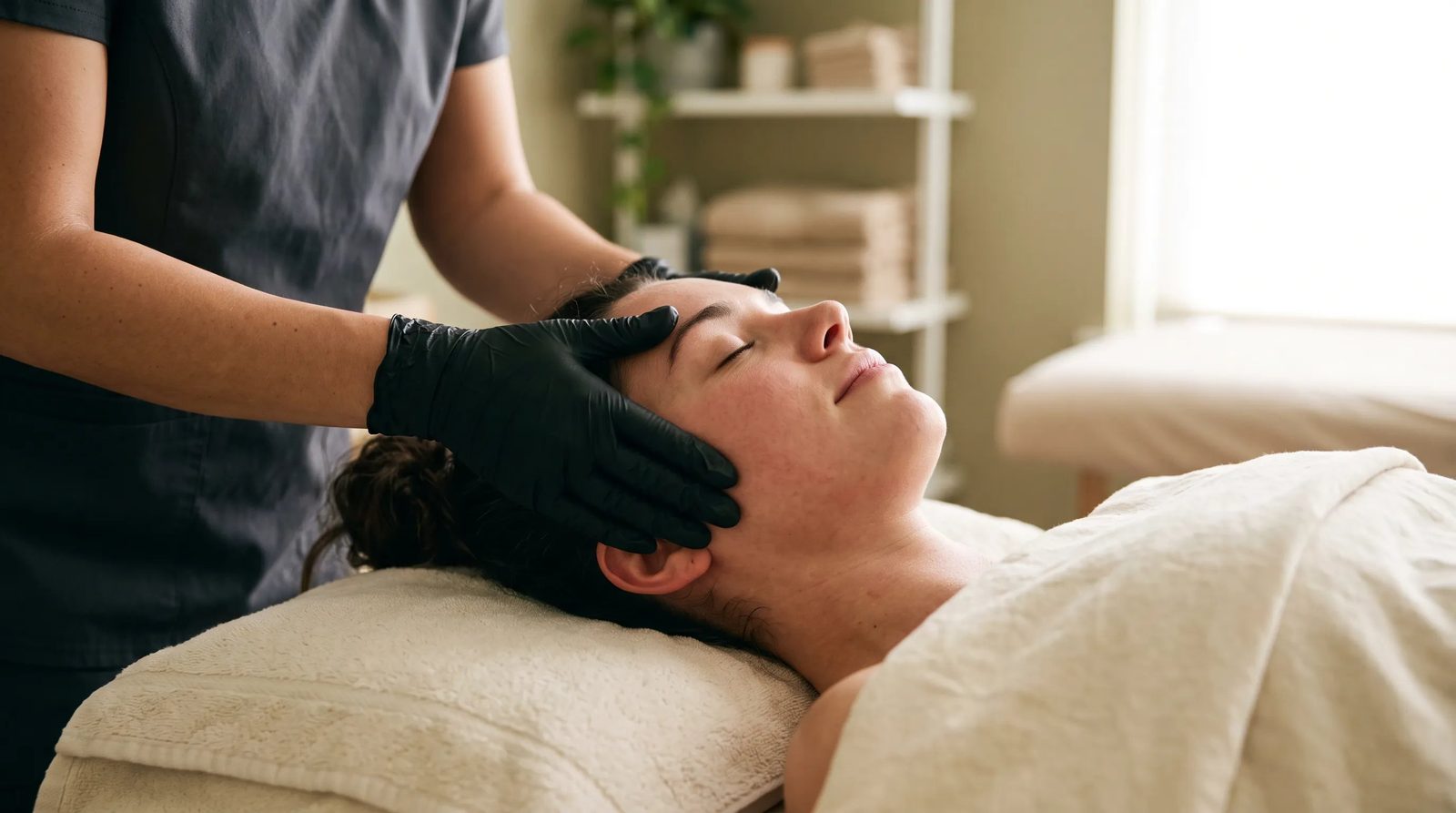
You know the feeling before you can name it. The morning face that looks puffier than it should. The under-eye bags a full night of sleep no longer clears. And that heavy, slightly foggy sense behind your eyes, like your head is running a half-step slow. None of it is dramatic. All of it is real, and it tends to show up together.
Your body has a drainage system, and it runs through your face
People search for a fix in two directions. Some want to know how to depuff their face. Others want to understand the foggy, heavy-headed feeling. It turns out those two questions are closer than they look, because both trace back to the same quiet plumbing in your head and neck: the lymphatic system, and its newer-understood cousin in the brain.
Let us walk through what is known, what is still being studied, and where gentle facial and head lymphatic drainage may fit.
Most people know about blood. Fewer think about lymph. Your lymphatic system is a network of vessels and lymph nodes that carries fluid, waste, and immune cells out of your tissues. When it moves well, tissue feels light. When fluid lingers, tissue looks puffy and feels heavy.
Here is the part that surprises people. Your face and neck are dense with lymph nodes. The lymph nodes in your face and around your jaw and neck are the drainage stations that clear fluid from the tissue above them. Under-eye puffiness, jaw fullness, that swollen-morning look. A lot of it is simply fluid sitting in the tissue, waiting for those nodes to move it along.
Unlike your blood, your lymph has no pump of its own. As our founder Sharon Vogel explains it:
"It siphons and draws fluid. It does not push fluid around. It doesn't squeeze swelling."
That is why gentle, light-touch work can encourage facial fluid to move toward the nodes that clear it. It is not about pressing harder. It is about opening the route and drawing the fluid the way the system already wants to go.
The glymphatic system: your brain's overnight clean-up crew
Now the newer piece. In the last decade, researchers described what they named the glymphatic system. Think of it as a waste-clearance pathway inside the brain. While you sleep, cerebrospinal fluid appears to flush through brain tissue and carry away metabolic waste that builds up during a busy day. Much of that clearance seems to happen at night, which is one reason poor sleep and a foggy head so often travel together.
The glymphatic system is thought to connect, further downstream, to the lymphatic vessels in the neck and around the skull. Fluid that leaves the brain has to go somewhere, and the neck is a key exit.
A few honest words here. Glymphatic research is still developing. Much of the early work came from studies in animals, and scientists are still mapping exactly how the human glymphatic system behaves, what speeds it up, and what slows it down. It is a genuinely exciting area, and it is not settled science. Anyone promising you a guaranteed brain detox is getting ahead of the evidence.
So where does brain fog come in?
Brain fog is not a diagnosis. It is a description. People use it for that fuzzy, slow, "can't quite focus" state that can follow poor sleep, illness, stress, hormonal shifts, or a long stretch of feeling run down. Many things cause it, and most of them have nothing to do with your lymph.
That said, the felt experience often clusters. A heavy head, a puffy face, sluggish mornings. When people ask about brain fog massage or head and neck lymphatic drainage, they are usually chasing that whole cluster rather than one symptom.
What we can say plainly is this. Gentle head, face, and neck lymphatic drainage may support how light and clear your head and face feel by encouraging fluid to move toward the nodes that clear it. For some people, that lighter, less-puffy feeling is exactly what they are after. What we will not say is that lymphatic drainage treats, cures, or reverses brain fog, or any neurological condition. It does not, and the research does not claim it does. If your foggy thinking is persistent, worsening, or paired with other symptoms, that is a conversation for your physician first.
Sharon keeps the honest frame front and center:
"There's not just one way to do lymph drainage, because everyone's different."
How to depuff your face, the gentle way
If depuffing is your goal, the good news is that the same principles apply, and you can support fluid movement at home between anything else.
Keep it light. Pressing on puffiness tends to hurt and does not move the fluid causing it. Light, slow strokes do more.
Start at the neck. Clear the drainage route at the neck and collarbone first, then work upward toward the cheeks and under-eye area. Fluid moves toward the nodes that are ready to receive it.
Move down and out. Guide gentle strokes from the center of the face toward the ears and down the neck, following the pathways your body already uses.
Support the basics. Sleep, hydration, and less overnight salt all give your natural overnight clearance a better chance to do its job.
At-home care is real, and it helps. It is also different from a clinical session. Professional manual lymphatic drainage of the head, face, and neck follows your anatomy in a specific order, with the neck and clavicle opened before anything in the face is drawn. That sequencing is the part most home routines miss.
When it is not right, and when to check first
Gentle as it is, lymphatic work is not for everyone. We do not perform drainage on patients with AFib, COPD, emphysema, blood clots, or an active infection. Those are outside our scope of care. And one rule from Sharon's teaching guides every session:
"You never push fluid toward an obstruction."
If you are managing a diagnosed condition, recovering from surgery, or in cancer treatment, the timing and approach matter, and we coordinate with your care team before any work begins.
The clinical version, if you want it
Reading about the mechanism is one thing. Feeling a professional head, face, and neck session is another. Our therapists are trained in manual lymphatic drainage across all three clinics, and this is clinical drainage work rather than a general massage. Sharon Vogel holds her LMT, CLT, BCTMB, CVMLD, and a BS in Biomedical Science, and she built the Vogel Method over more than three decades of hands-on work. National Lymphatic Centers has cared for patients since 1991, and carries a 4.8 star rating across 1,000+ reviews on Google, Yelp and more at our three Illinois clinics.
If the puffiness, the under-eye fullness, or that heavy-headed feeling is what brought you here, the facial lymphatic drainage page walks through what a clinical face and head session looks like and how to book one. To see the full picture of how we work and every condition we treat, start with the manual lymphatic drainage hub. And if you would rather just talk it through, tell us what you are noticing and we will say honestly whether gentle drainage can help.
More plain-language explainers like this one live in our education library.