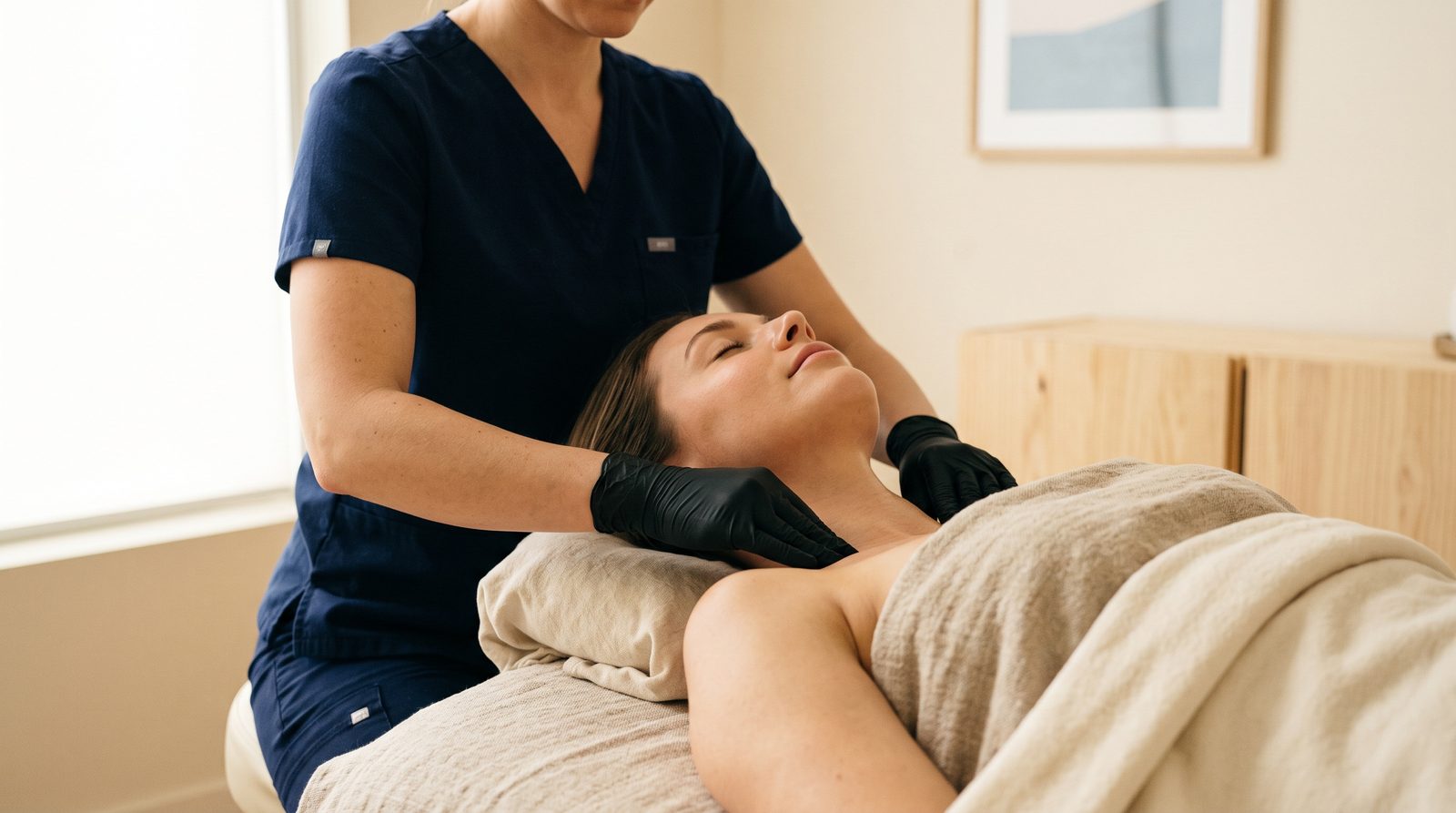
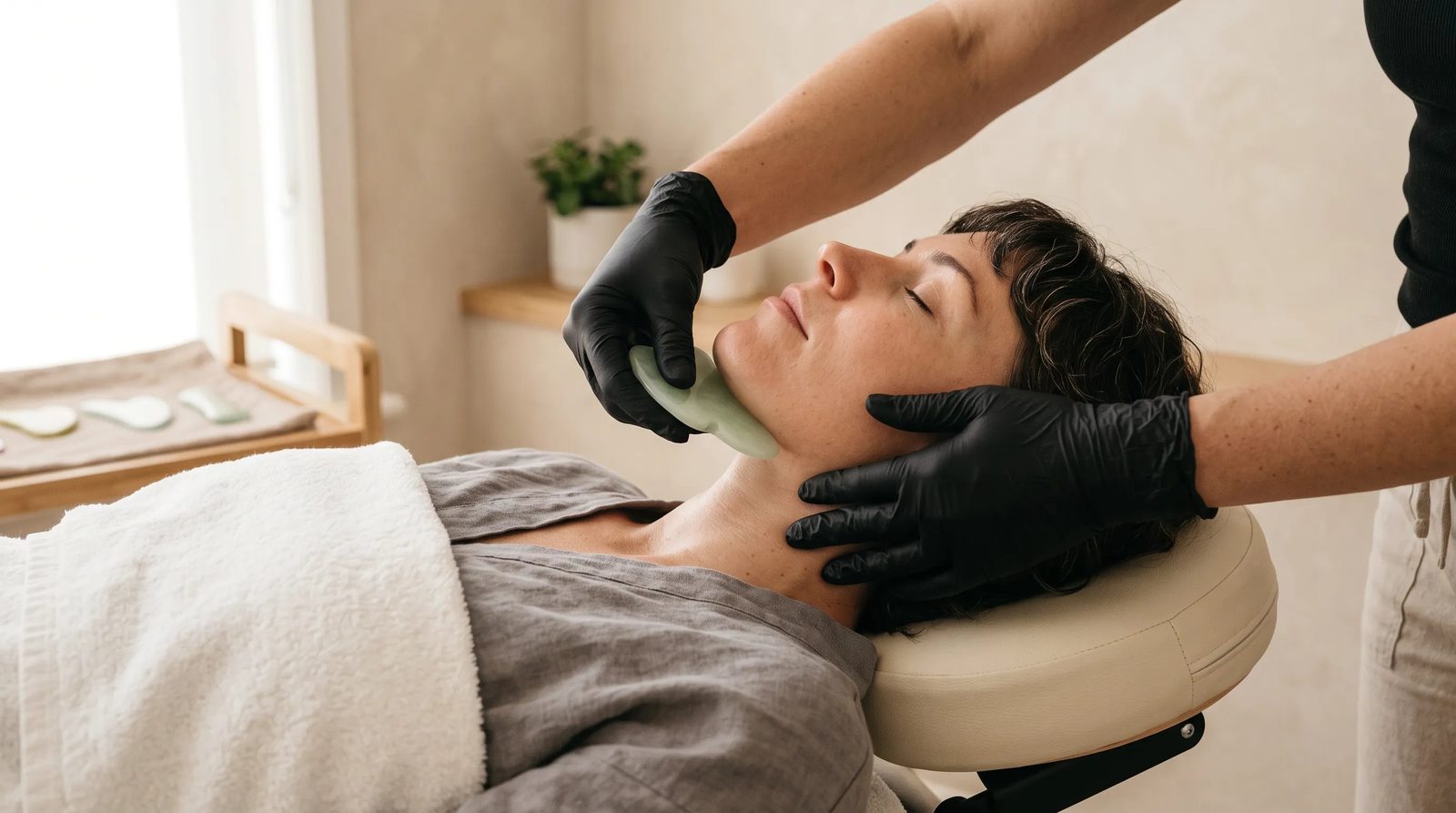
Have you ever run a gua sha stone across your jaw because a video told you to, and wondered whether you were actually helping anything or just moving skin around? It is a fair question. A smooth stone gliding along your face feels nice, but "feels nice" and "works with your lymphatic system" are two different things. The good news is that a few small choices turn a pleasant five minutes into a routine that actually follows how the fluid under your skin wants to move. Our founder, Sharon Vogel, recorded a short guide on exactly this. What follows is her at-home approach, the same gentle self-care she sends patients home with between visits. Think of it as homework, a light supplement to hands-on work, not a stand-in for it.
What is gua sha, and can it help lymphatic drainage?
Gua sha is a traditional technique that uses a smooth-edged tool, usually stone, to stroke along the skin. In a lymphatic context the goal is to give the surface of your skin a light, directional nudge that your lymphatic vessels respond to. The pressure stays feather-light, with no deep pressing or scraping of muscle.
That matters because your lymphatic system sits just under the skin and has no pump of its own. It relies on movement and gentle stimulation to keep fluid heading the right way. A stone drawn softly across the surface is one way to offer that stimulation at home. Sharon keeps returning to the same word for how light it should be:
"The lymphatic system responds to gentle."
So the tool is almost beside the point. Sharon demonstrates with a wand, a textured roller, a little mushroom-shaped stone, even the flat stick from a dry brush, and finally her own hands. The technique is what carries the work, not the object in your grip.
Why does gentle matter so much?
Because you are guiding a current, not scrubbing a surface. Picture water rather than muscle. Sharon frames the mistake most people make in a single image:
"We don't want to create a whirlpool or a tornado. We want a gentle stream of where we're putting the water."
Hard, fast, back-and-forth strokes churn the fluid instead of moving it somewhere. A calm, one-direction pass gives it a place to go. She puts the pace plainly:
"It doesn't have to be hard and fast. It's a water current."
This is also why lymphatic gua sha should never hurt. If you are bearing down hard enough to feel it in the muscle, you have left the lymphatic layer behind.
Sharon's 5-minute technique, step by step
Here is her sequence for a gentle at-home pass. Move slowly, keep the pressure light enough that it feels soothing, and stop if anything feels tender.
Open the drain first. Before you touch any area of puffiness, clear the exit route. Find your collarbone, the soft hollow just above it, and the sides of your neck. This is the terminus, where lymph returns toward your bloodstream. Sharon is firm about the order: "You have to start by first opening up the drain."
Work from the center outward, gently. With the drain open, you can move to the face. Light strokes under the jaw, along the cheekbones, and around the eyes, always guiding fluid back toward that open neck route.
Go one direction, like a squeegee. Rather than sawing back and forth, make slow single-direction passes toward the neck. You are sweeping, not scrubbing.
Switch tools for bigger areas. The flat stick from a dry brush covers the low back or the back of the leg quickly because it has a long, smooth surface. A small mushroom-shaped stone suits the delicate areas around the eyes and jaw. Cool tools, kept in the refrigerator, feel especially good.
Finish with your hands. You do not actually need a tool at all. Your own hands can do the same gentle, directional work, which makes this something you can do anywhere.
Sharon's kitchen comparison is the one most people remember:
"If you're doing the dishes and you want to do the dishes with the water running, aka manual lymphatic drainage, open up the drains first."
Open the drain, then run the water. Do it in the other order and the fluid has nowhere to travel. She even frames it as a question worth asking yourself before you start:
"If you're going to start lymphatic drainage, where are you going to drain it to?"
Does gua sha "detox" you?
This is where honesty matters more than a nice-sounding promise. People reach for gua sha expecting a "detox," and Sharon draws a careful line around that word. When someone scrubs back and forth without following the body's drainage map, she notes:
"You can, but it's not detoxifying and moving fluids according to the way the lymphatic system goes."
Read that closely. Sharon draws a careful line here: random scrubbing and working along the lymphatic pathways are worlds apart. Gentle, directional gua sha may help your body do what it already does, which is move interstitial fluid along its natural route. That is the whole claim, and it is a modest one.
Where this fits, and where it does not
At-home gua sha is a lovely daily ritual. It can leave your face feeling lighter, it gives you a calm few minutes, and it keeps you connected to how your own tissue feels day to day. Used gently and in the right order, it supports the everyday movement of fluid.
It remains a supportive habit for everyday care. Gentle self-care at home does not replace trained manual lymphatic drainage for lymphedema, lipedema, or post-surgical swelling. Those situations call for a certified lymphedema therapist who can assess you, work in the correct clinical sequence, and know when a symptom needs a physician instead. Some conditions should not be self-treated at all. If you are managing diagnosed swelling or recovering from surgery, treat gua sha as the light supplement between professional sessions, not the plan itself.
Sharon closes her guide the way she closes a session, and it is a good note to end on here too:
"Thank you so much for taking this time with me today."
If you want to understand the hands-on work this routine supports, our manual lymphatic drainage page walks through the treatment, and the benefits of lymphatic drainage page covers what people notice from it. Curious which tools she uses on camera? A few live on our recommended products page.
If you are dealing with swelling that lingers, keeps returning, or follows a surgery, tell us what is going on and we will say honestly whether this work can help. You can keep learning anytime in our education library.