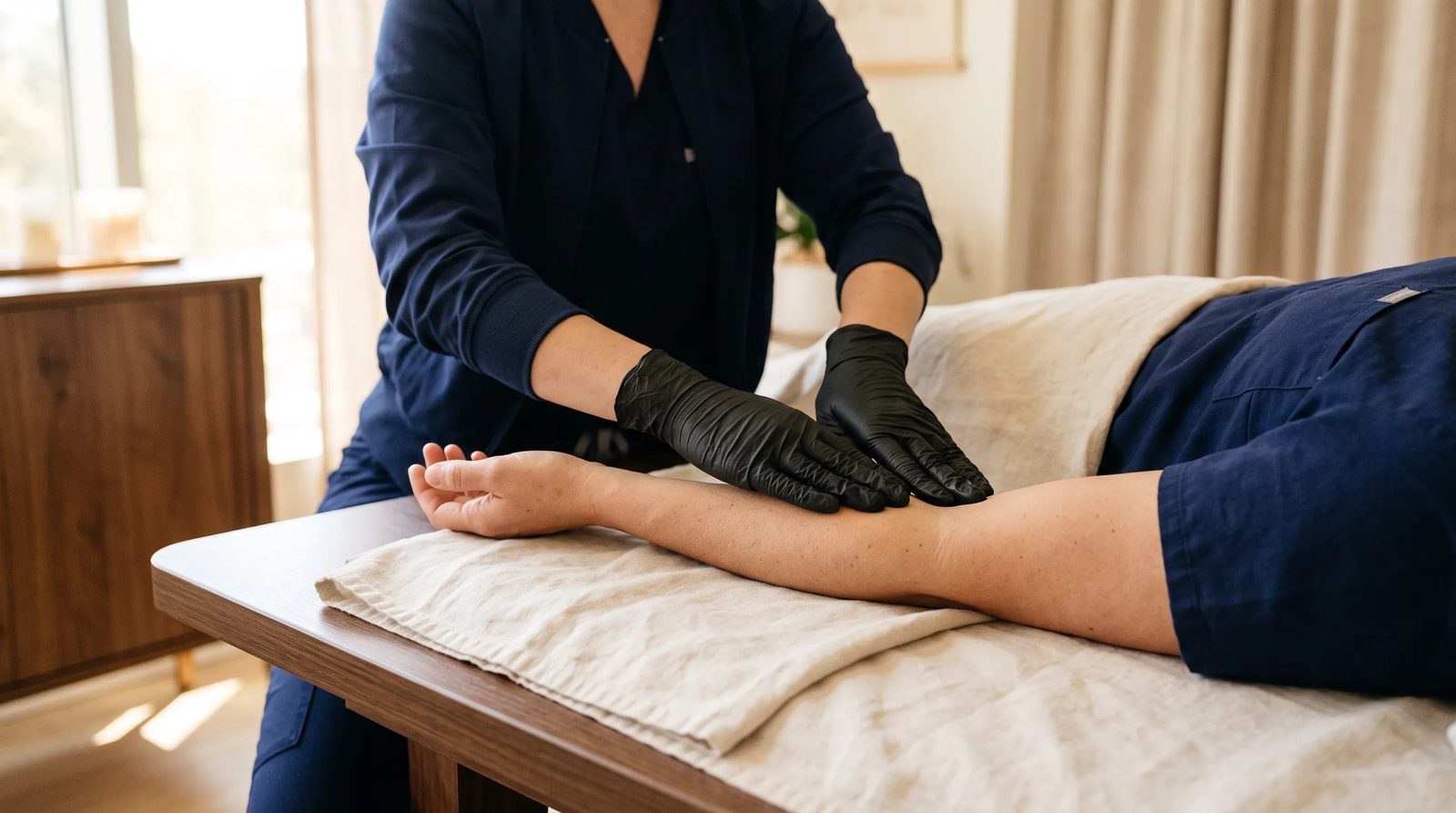
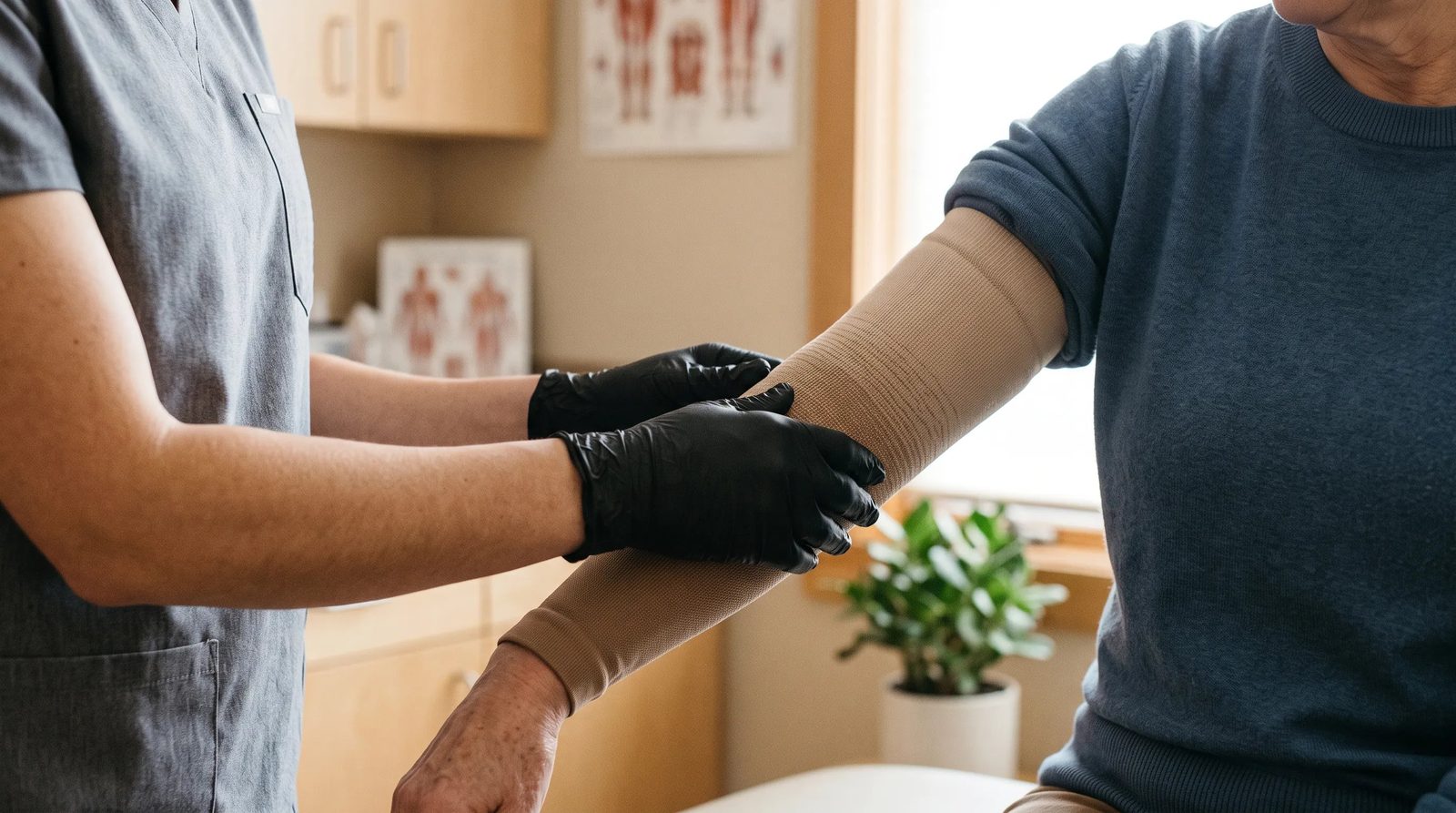
Why would an arm stay swollen and heavy even while it is wearing a compression sleeve? It is one of the most common questions we hear, and the answer surprises people. A sleeve is a container. It holds the ground you have already gained, and it cannot move fluid on its own. If the fluid has nowhere to go before the sleeve goes on, the sleeve cannot create a path that was never there to begin with. This is a plain-language look at two tools that come up constantly in lymphedema care, compression sleeves and pneumatic pumps, and the single question that decides whether either one helps you or works against you: is the fluid actually draining?
Why doesn't my arm drain even though I'm wearing a compression sleeve?
Start with what a sleeve is for. Compression supports a limb that is already moving fluid in the right direction. It does not open a route on its own. Our founder, Sharon Vogel, puts the underlying problem plainly:
"One of the definitions of lymphedema is that the fluid can't get out for one reason or another. Maybe the sleeve is too small. Or maybe you just need to drain the arm or the leg."
So a swollen arm inside a sleeve usually points to one of two things. The sleeve may be the wrong size, gripping in a way that pinches the flow instead of guiding it. Or the limb was congested before the sleeve went on, and no amount of compression will move fluid that has no open path ahead of it.
Sharon gives a simple tell to look for:
"If you have a sleeve that leaves a deep red mark right on the shoulder area, maybe this part is congested and you just need to drain it."
That red mark near the top of the shoulder is a clue that the fluid is backing up before it ever reaches the place it needs to exit. The exit she means is a small hollow above the collarbone called the supraclavicular fossa, one of the body's main drainage points. If that area is not clear, the sleeve has nothing to work with.
What a sleeve can and cannot do
Here is the sequence that protects you. The route closer to the center of the body opens first, so the fluid further out has somewhere to travel toward. Sharon describes the whole idea with a housekeeping picture that sticks:
"When you drain, you have to make sure to get all the dust to the dust pan."
You clear the dustpan's path first. Then you sweep toward it. A sleeve applied to a limb that has not been drained is like sweeping dust toward a pan that is already full. The work has nowhere to land.
Her practical guidance follows from that:
"If you're wearing a sleeve that's uncomfortable, look at the arm before the sleeve."
Discomfort is information. A sleeve that hurts, pinches, or leaves deep marks is telling you something about the limb underneath it, and that is a conversation to have with a certified therapist rather than a problem to push through.
When is a pneumatic pump the right tool?
A pneumatic pump is a sleeve-like device that inflates in sequence to encourage fluid along a limb. Like a compression sleeve, it is a helper rather than a starter. It works when a path is already open. Sharon is direct about the timing:
"You use pneumatic pumps when the fluid is draining."
How do you know fluid is draining? She describes the signs in everyday terms. The limb responds to belly breathing. It softens with gentle skin sweeping. It measures smaller in the morning than it did the night before. The junctures at the groin, behind the knee, and at the ankle feel open and flowing. When those signs are present, a pump can support work that is already underway.
The reverse matters just as much. She names the moments when a pump is the wrong choice:
"But not if a limb is weeping or it's wet, not if it's stuck, because you don't want to push fluid toward an obstruction ever."
A limb that is weeping, hot, or stuck is not ready for added pressure. Pushing on it can force fluid against a blockage and make matters worse. This is why a pump is never a self-directed decision on a limb that is not already moving.
The one rule that protects you
If you remember nothing else, remember this. Sharon teaches it as a hard line, and it governs every tool in lymphedema care, sleeves and pumps included:
"You don't want to push fluid toward an obstruction ever."
An obstruction can be scar tissue, a surgical site, removed lymph nodes, or a tumor. Forcing fluid toward any of those is the one thing skilled lymphatic work is built to avoid. When you meet an obstruction, her instruction is simple: go around it. This is also the reason the order of care matters so much, and why a device that seems straightforward can do harm in the wrong week. The sequence is not busywork. It is the safety.
This is where the honest answer comes down to a proper evaluation:
"Best thing to do is see a CLT, a certified lymphedema therapist who will do an evaluation and assessment. They'll let you know just what you need."
Why measurement and fit come first
Almost every problem above traces back to the same starting point, a limb and a garment that were never properly matched. A sleeve that pinches, a pump used too early, an arm that stays congested, all of it is easier to prevent than to fix. Sharon's advice is unglamorous and correct:
"Make sure to be measured by a CLT for measurements that are correct, and you'll be on the right road."
Correct measurement is what makes compression support your flow instead of fighting it, and a proper assessment is what tells you whether a pump belongs in your routine yet. If you manage ongoing swelling, our lymphedema measurements page is the place to begin, because the fit and the sequence are decided there before any sleeve or pump enters the picture.
To see how compression and pumping fit into the larger plan, our lymphedema therapy page walks through ongoing management, and our complete decongestive therapy page covers the full standard of care these tools are meant to support.
A sleeve and a pump are good tools in the right hands and the right week. The skill is knowing which week that is. If you are unsure whether your fluid is draining, tell us what is going on and we will help you find out. You can also keep reading in our education library.