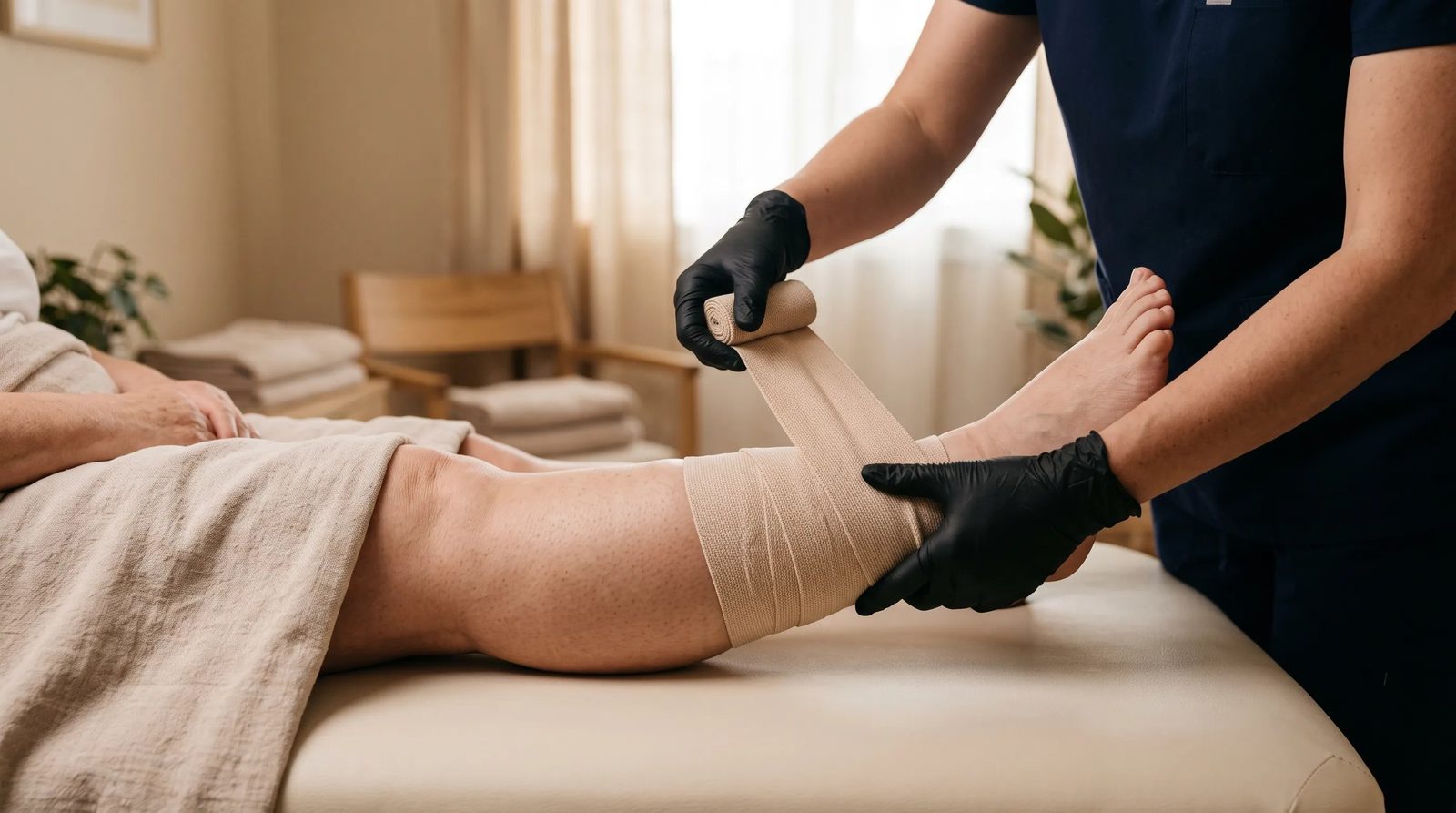
Can everyone have manual lymphatic drainage? It is a fair question to ask before you book anything, and the honest answer is no. For most people this gentle work is a calm, comfortable hour. For a small group with certain heart and lung conditions, the same work carries real risk, and the safest place to receive it is not our clinic at all. We would rather tell you that up front than discover it on the table.
This is a plain-language look at why atrial fibrillation (AFib) and some breathing conditions change the picture, why the safest care for those patients happens inside a hospital, and how we screen for all of it before anyone begins.
Why would a lymphatic therapist ever turn someone away?
Because the work does exactly what it is designed to do. Manual lymphatic drainage moves fluid. When someone is in good general health, that fluid travels back toward the center of the body and rejoins the circulation without any trouble. The heart takes on the returning volume the way it is built to.
The concern begins when a heart or a set of lungs is already compromised. Moving a large volume of fluid back toward the core asks the heart to handle more, and a heart that is struggling with an irregular rhythm or reduced capacity may not be able to. That is the whole reason certain conditions sit on the "extra care" list. The technique is effective at mobilizing fluid, and that same effectiveness is what makes screening essential first.
What does AFib have to do with lymph drainage?
Atrial fibrillation is an irregular, often rapid heartbeat, and it is one of the conditions National Lymphatic Centers does not treat with hands-on drainage. A patient named Jenny asked our founder, Sharon Vogel, this exact question on camera. Here is how Sharon explained the mechanism:
"It's a contraindication. It's going to flood the heart with a lot of fluid. And if the blood vessels are constricted, it can't handle that. It puts too much pressure on the heart."
Read that as a reason, because that is how she means it. The point of the sequence a trained therapist follows, and the point of screening someone before a single stroke of work begins, is to keep fluid from being sent toward a heart that cannot safely take on the extra volume. When the heart is already working against an irregular rhythm, that added pressure is not a risk anyone should manage on a spa table.
So for a patient with AFib, our answer is a referral rather than an appointment. Sharon puts the boundary plainly:
"If there's lymphedema present, you go to a hospital lymphedema clinic where they have emergency care just in case. That is the truth."
Why do breathing conditions change the plan too?
The lungs sit right in the path of this work. Deep breathing is part of how lymph moves through the chest, so when a lung condition already makes breathing harder, flooding the area with fluid can add strain to a system that is stretched. Conditions such as COPD and emphysema fall into this same "extra care" category for that reason.
When Sharon was asked about drainage for people with breathing conditions, she described why the volume and the pace both matter:
"You can't flood the heart and lungs with so much fluid."
That is why, in the settings where this work is done safely for such patients, it is kept short and slow, sometimes only ten or fifteen minutes at a time rather than a full hour. Pace becomes part of the safety, and a hospital clinic is the environment built to manage it.
How does the order of the work keep it safe?
There is a rule that governs how skilled lymphatic work is sequenced, and it doubles as a safety measure. You do not start where the swelling is. You open the pathway closer to the center of the body first, so the fluid further out has a clear route toward it and nothing gets pushed toward a heart or a pair of lungs faster than they can cope. Sharon describes the sequence this way:
"Get this part draining, because if this is draining, it will siphon more. Not the whole body yet."
Clearing the route before drawing the fluid is a general principle of how the system moves, and it is one more reason lymphatic work on a medically complex patient is a clinical skill that belongs with the right team in the right place. If you would like to see how a standard, healthy-patient session is paced, our what to expect page walks through it.
Where do these cases belong, and why a hospital?
For patients with AFib, COPD, emphysema, blood clots, or an active infection, the safest setting is a hospital lymphedema clinic where emergency care is on site. The work often can help these patients under the right supervision. The reason for the hospital setting is simple: if a compromised heart or lungs were to react, the people and equipment to respond are already in the room.
Sharon is clear that sending someone to the right setting is itself a form of care:
"You still need lymph drainage. You still need to learn how to do it, and we're happy to teach you, absolutely. But for the hands-on, it's in-hospital care."
For a breathing condition, the safest first step is often a conversation with your physician, and having your doctor confirm in writing that manual lymphatic drainage is appropriate for you. Every case is genuinely individual, which is why the answer is never one-size-fits-all.
How does NLC handle this before you ever book?
We screen for these conditions during your consultation, before any hands-on work is scheduled. If you have AFib, COPD, emphysema, a blood clot, or an active infection, we will tell you honestly that hands-on drainage with us is not appropriate, and we will point you toward a hospital lymphedema clinic that can provide it safely. We would rather be the honest referrer than the clinic that took a booking it should have declined.
If you are living with ongoing swelling from a lymphatic condition, our lymphedema therapy page is the place to start, and our FAQ answers more of the common safety questions. If you are unsure whether your own health history is a fit, tell us what is going on and we will give you a straight answer. You can also keep reading in our education library.