Most people who search this have already felt the pull. You work with your hands, or you want to, and lymphatic work keeps coming up. Patients ask about puffiness and swelling. A friend swears by their drainage sessions. You looked into it and found a wall of weekend courses that promise a certificate by Sunday. So the real question underneath the search is a fair one. What does it actually take to do this work well, and where do you go to learn it? Here is the honest map. Becoming a lymphatic drainage therapist is a two-part path. First you become a licensed bodywork professional. Then you train in lymphatic drainage as a clinical technique. The gap between those two steps is where most of the confusion lives, so we will walk it in order.
Step one: get licensed to touch clients
Lymphatic drainage is hands-on clinical work, so nearly every path to it starts with a professional license that lets you work on a client's body.
For most people that means becoming a licensed massage therapist (LMT). You complete an accredited massage program, which in most states runs somewhere in the 500 to 750 classroom-hour range, then pass a licensing exam and register with your state board. An LMT license is the foundation the rest of this builds on, because it is what legally lets you deliver bodywork.
Massage therapists are not the only ones who do this work. Nurses and physical or occupational therapists already carry a clinical license and often add lymphatic training to help patients with post-surgical or oncology swelling. Aestheticians work within the scope of their own license, typically on facial and cosmetic drainage instead of medical lymphedema. The point holds across all of them. You need a license that permits the hands-on work before the lymphatic technique means anything.
If you are still choosing a starting license, pick the one that matches the work you want to do. Someone who wants to manage medical lymphedema is served well by a massage or clinical-therapy license. Someone drawn to facial drainage and skin health may find an aesthetics license fits.
Step two: train in lymphatic drainage as a real technique
A general massage license teaches you the body. It does not teach you manual lymphatic drainage (MLD), which is a distinct skill with its own physiology, sequence, and safety rules. This is the second half of the path, and it is the half that separates a competent lymphatic therapist from someone who took one class and improvised.
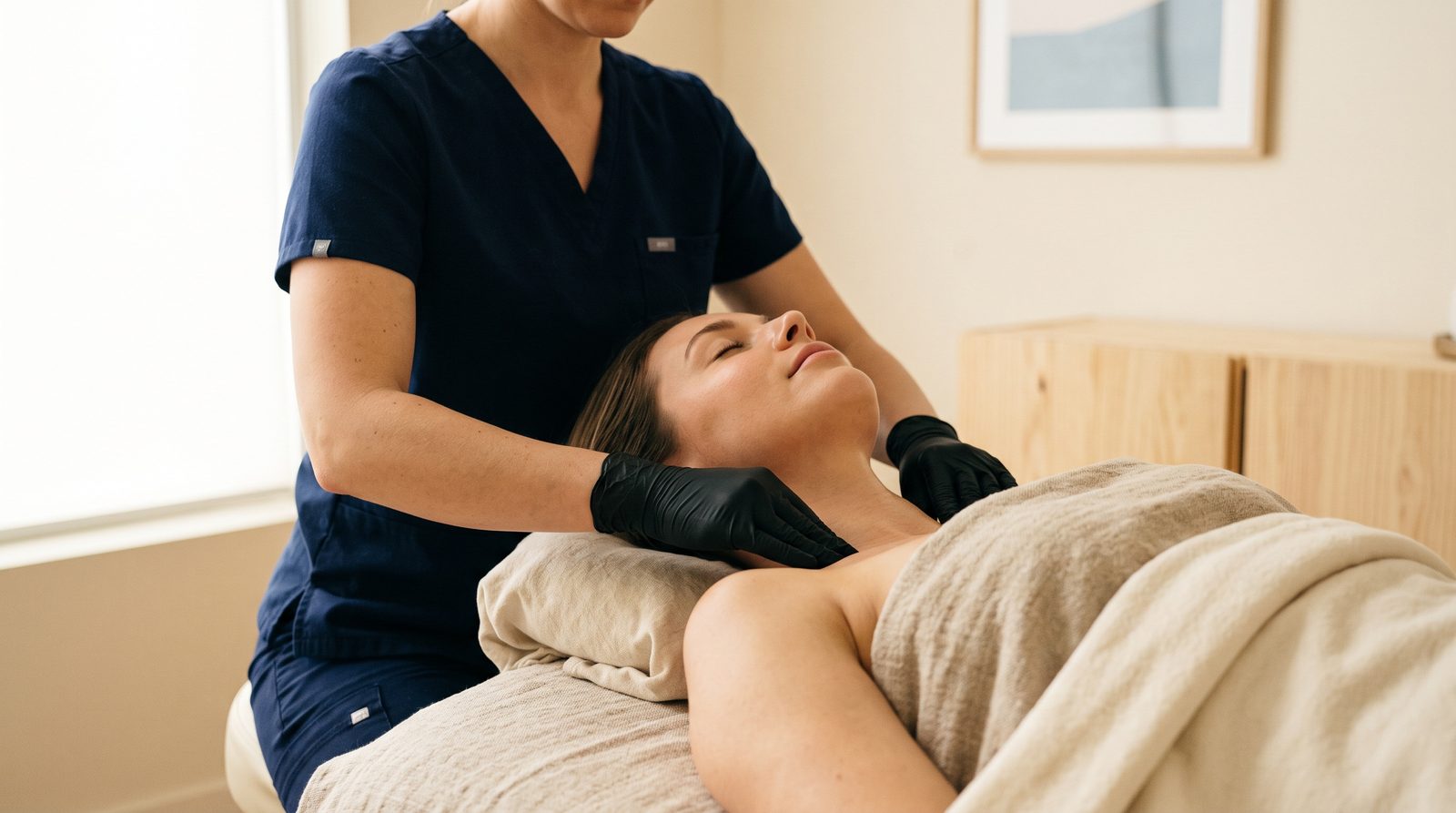
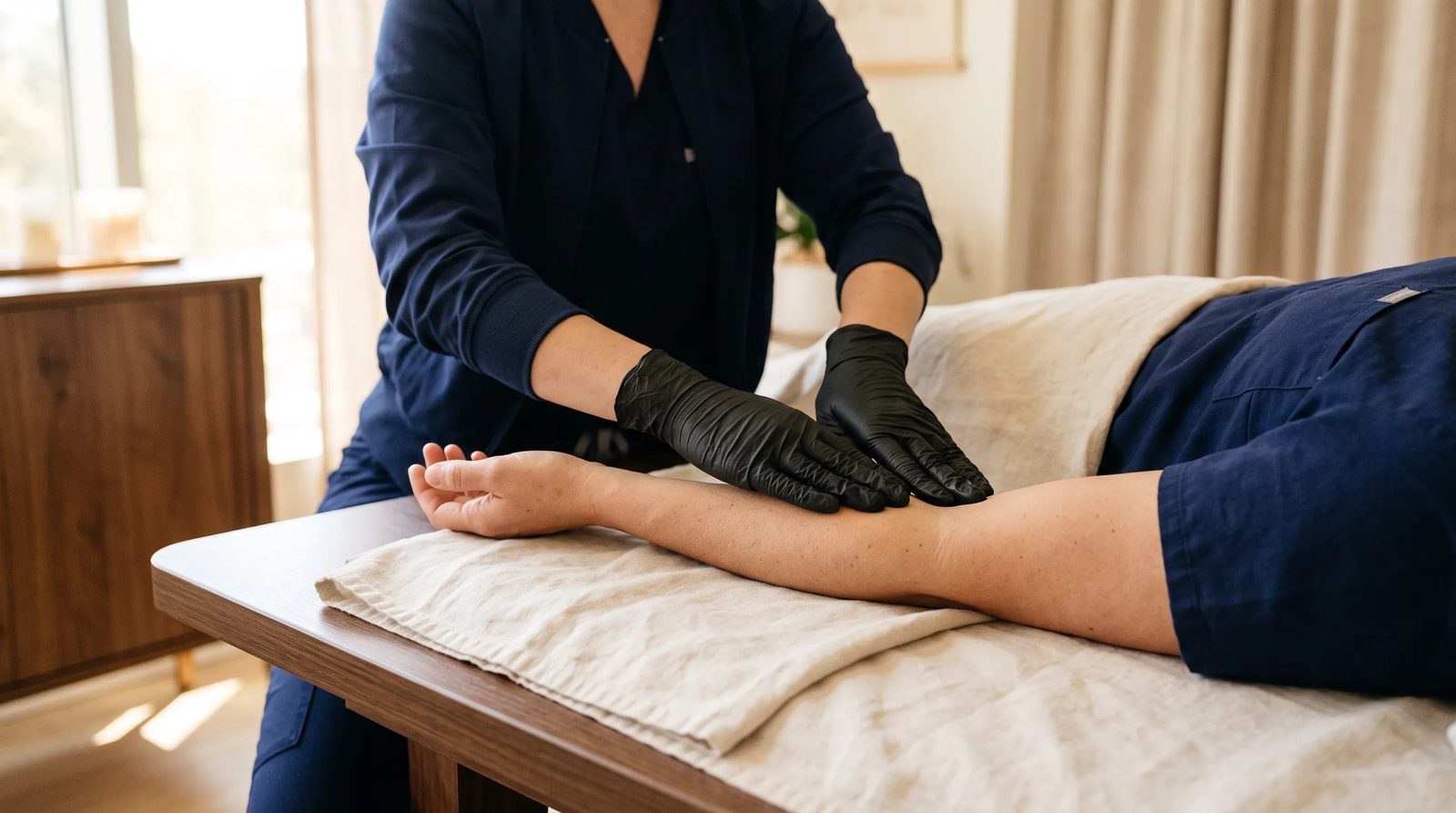
MLD is a gentle, skin-level technique that moves fluid toward the lymph nodes that clear it. Your lymph has no pump of its own the way your blood does, so it depends on movement and light stimulation to keep draining. Done right, the work is careful and specific. Our founder Sharon Vogel puts the mechanism plainly:
"It siphons and draws fluid. It does not push fluid around. It doesn't squeeze swelling."
That sounds simple. Learning to do it safely is not, because lymphatic work carries real contraindications. There are conditions where drainage is unsafe without medical clearance, and there is a governing rule Sharon teaches every therapist she trains:
"You never push fluid toward an obstruction."
Proper training covers all of it. The physiology of why lymph responds to gentle stimulation. The drainage order that opens the route nearest the heart first. Reading contraindications so you know when to refer a patient out instead of treating them. Assessment, so you read each body in front of you instead of running a fixed script.
The weekend course and the real training
Search "lymphatic drainage certification" and you will find plenty of one-day and online options that hand you a certificate the same afternoon. It is worth being clear-eyed about what those are and are not.
A short course can introduce the idea and teach a few strokes. What it usually cannot do is give you enough supervised hands-on time to read a real body, respond to a contraindication, or manage a patient whose swelling has a medical cause. Depth comes from hours at the table with a teacher watching your hands. A slideshow cannot supply it.
Real training tends to share a few traits. It is taught by someone who practices the technique, includes substantial hands-on instruction, and covers safety and assessment alongside the stroke patterns themselves. The most respected lymphatic education in the field comes from established programs with decades of history and public directories of the therapists they have trained. When you evaluate any program, ask who teaches it, how much of it is hands-on, and what the curriculum actually covers.
Where the certified lymphedema therapist path fits
If your goal is medical lymphedema management, there is a specific credential worth understanding. A certified lymphedema therapist (CLT) is a licensed clinician who has completed advanced training in Complete Decongestive Therapy, the gold-standard protocol for managing lymphedema. CLT training runs well beyond a weekend, typically around 135 hours, and is built for therapists treating diagnosed lymphedema patients.
A favorite of ours at NLC is the Academy of Lymphatic Studies, www.ACOLS.com, an accredited school for CLT training in Complete Decongestive Therapy.
A separate professional certification, LANA, exists for lymphedema therapists who sit an independent board exam after meeting experience requirements. It is one of several recognized markers in the lymphedema field.
The distinction matters for how you plan your training. A certified lymphatic drainage therapist learns MLD as a technique for swelling, recovery, and wellness drainage. A CLT carries the added clinical depth to manage medical lymphedema. Many therapists start with foundational MLD training and add lymphedema certification later as their practice grows.
At National Lymphatic Centers, our founder Sharon Vogel is a Licensed Massage Therapist and a Certified Lymphedema Therapist, is Board Certified in Therapeutic Massage and Bodywork, holds the CVMLD, and earned a BS in Biomedical Science. That biomedical grounding shapes how she teaches the physiology behind the hands.
Training with the Vogel Institute of Lymphology
One path into MLD training is the Vogel Institute of Lymphology, the teaching arm Sharon founded to pass on her method to other professionals.
The straight version, because you are researching a career and deserve it: the Institute is young. Sharon founded it in 2021, and it operates inside our working clinic. We do not claim the Vogel Method is taught across the country or count how many clinics use it. What we can tell you is checkable. Sharon built the technique over three decades, founded National Lymphatic Centers in 1991, formalized her approach into a taught curriculum, and now trains professionals in it under one roof. You learn the method from the practitioner who developed it, at the tables where it is used every day.
For some people that origin is exactly the appeal. For others, an established national program with a large public directory will fit better. Both are legitimate, and a good decision starts with knowing what each one offers.
Your next step
If you are early on the path, get your foundational license first, then choose your lymphatic training with your eyes open. Ask who teaches it, how much is hands-on, and whether it covers safety and assessment alongside the technique itself.
If you want to explore training in the Vogel Method specifically, the Vogel Institute of Lymphology page lays out the classes, the teacher, and how continuing education credit can apply to your license. You can also see our current open therapist roles if you are already trained and looking to practice, browse more career and clinical guides in our education library, or reach out with a question about where to begin.
Lymphatic work rewards therapists who learn it properly. Start with the license, train in the technique with someone who practices it, and build from there.